

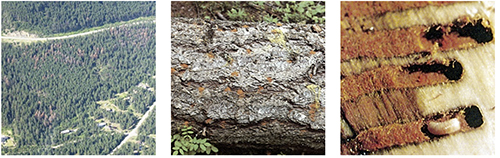
Some waterfront owners in the Sunnybrae area have hired Cory Matheson to help control the Douglas-fir Bark Beetle. Cory gives an annual forest health assessment to the owners. Cory has agreed to allow SWOA to share his report with SWOA members. Cory's contact information is below if anyone is interested in helping to control the Douglas-fir Bark Beetle.
Douglas-fir Bark Beetle Pheromone Management and general Forest Health Assessment is now complete.
Current observations from 2025/2026 indicate a decline in Douglas-fir mortality attributed to bark beetles, with active populations now largely occurring in scattered pockets across the landscape rather than as widespread mortality events. While this trend is encouraging, I do not recommend letting our guard down. Bark beetle populations can respond quickly to changing environmental conditions, such as drought, heat events, and especially any new green wind-felled or downed douglas fir trees, could contribute to another population spike. We will continue monitoring these trends closely.
Some active Douglas-fir bark beetle activity persists above, within the working forest/public lands. The 2026 mortality along the lower lake edge, dry ridges, and exposed south-facing slopes has declined.
Ensure to keep the Pheromone patches attached, as the bark beetle flight is underway, typically continuing through late August. Douglas-fir bark beetle incidence remains low in areas treated with pheromone patches over multiple years, suggesting continued efficacy of the management program.
Recommendations to Reduce Bark Beetle Risk
· Avoid cutting live Douglas-fir during spring and summer. Major pruning or arborist work should ideally be scheduled after beetle flight, in August or later.
· Remove freshly cut (green) Douglas-fir material from your property, as volatiles released from fresh cuts can attract beetles during flight periods (April-August).
· Monitor for any dying trees, windfelled green trees or stress indicators for bark beetle presence. Plan for prompt removal, or peel and burn infested bark where appropriate (live brood generally remains viable for one year following attack).
· If another prolonged heat event occurs, supplemental watering of vulnerable trees may help reduce drought stress. Limited boron applications around the dripline may also improve tree vigor on nutrient-poor sites. Under normal conditions, Douglas-fir bark beetles generally avoid healthy trees.
Efforts to Date
Sunnybrae Area
Moderate Douglas-fir bark beetle populations occur primarily on the mid- to upper slopes above Sunnybrae Road. Reduced populations are evident along the lake and lower slopes. Assessments continue in areas where previous bark beetle populations were identified. Pheromone patches are increased around populations to detour them away. and especially to continuously to protect the largest-diameter and veteran Douglas-firs.
Salmon Arm Area
Douglas-fir bark beetle levels are down, near Salmon Arm. Assessments and pheromone patch placements were completed in the Raven subdivision and along Lakeshore Road.
Sorrento / Blind Bay / Eagle Bay / White Lake / North Shore / Sicamous
Assessments continue in some local parks and trail networks where previous bark beetle populations were identified, and pheromone patches were placed to protect large-diameter and veteran Douglas-fir. Below is an example of some of the areas:
· Upper Balmoral Trails, particularly along cutblock edges
· Shannon Beach upper trails
· Wild Rose Bay Park upper slopes (associated with an older windthrow event)
· Ferrels Field Park, forest reserve
· Evelyn Falls Trail
· Sicamouse Creek Trails
· CSRD and BC Parks throughout the Shuswap
Flatheaded Wood/Fir Borer Observations
Woodpeckers stripping bark from dying Douglas-fir had become increasingly evident throughout the region this past few years. Flatheaded Fir Borer spp. (including Phaenops drummondi) seem to be on the decline. They typically infest a tree after the Bark Beetle. So these declining trends are good news!
Closing Notes
Douglas-fir bark beetles and Flatheaded Fir Borers are native forest insects and natural components of our ecosystems. Although current mortality trends appear improved, I view this as reason for cautious optimism rather than reduced vigilance. Maintaining the pheromone program through lower-population years is, in my view, part of what helps prevent resurgence.
For that reason, I recommend continuing the program at this time, while monitoring for any environmental conditions that may trigger renewed beetle pressure.
I remain committed to maintaining this program and will continue providing updates and prudent management information as needed.
Respectfully,
J. Corey Matheson, RFT
Good Nature 250-833-8168